Africa, EU Green Deal and plight of smallholder farmers
‘Without bold investment, inclusive policies, and regional coordination, the EU Green Deal risks becoming a blueprint for poverty rather than sustainability’
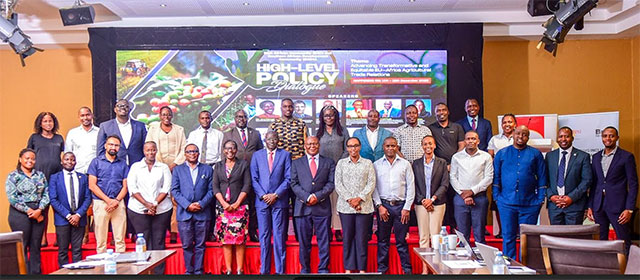
NEWS ANALYSIS | RONALD MUSOKE | The Speke Resort Hotel in Munyonyo buzzed with urgency on December 11-12, 2025, as policymakers, agronomists, and trade experts from Eastern and Southern Africa gathered for a high-level dialogue on EU-Africa agricultural trade. The focus was the sweeping European Union (EU) Green Deal, a suite of regulations reshaping global trade, and the challenge of ensuring that African farmers, especially women and youth, are not left behind.
The conversation was as technical as it was political, covering everything from deforestation-free supply chains to the cost of satellite-based traceability, and the uneven history of trade between Europe and Africa. What emerged was a stark reality: while the EU’s Green Deal promises environmental and human rights safeguards, its implementation could threaten the livelihoods of millions of African smallholder farmers.
The EU Green Deal: Promise meets pressure
“The EU Green Deal, including the EU Deforestation Regulation (EUDR) and the Corporate Sustainability Due Diligence Directive (CSDDD), represents a fundamental shift in agricultural trade governance,” Vahini Naidu, the Programme Coordinator of Trade for Development at South Centre in Geneva said via video link.
Naidu explained that, in principle, these instruments could promote “rights-based, environmentally sustainable supply chains by encouraging traceability, climate-smart production, and improved labour and environmental standards.” But, she warned, political developments within the EU threatened to weaken these goals.
“Moves to amend the EUDR and dilute elements of the CSDDD under pressure from corporate lobbies risk undermining the very human rights and environmental objectives these instruments claim to advance,” she said.
The challenge, she added, is the disproportionate burden on smallholder farmers. “Without adequate support mechanisms, simplified procedures, and inclusive governance, EU importers will increasingly source from large plantations, marginalizing smallholders, women, and young farmers.”
Compliance costs and the risk of exclusion
Across Africa, smallholder farmers face steep compliance costs to meet EU standards. According to findings presented by Naidu, “Smallholder farmers may be required to spend up to 75% of their annual income on compliance, while larger exporters absorb a much smaller share of their revenue.”
The costs are not hypothetical. Geolocation and satellite verification for EUDR compliance range from €200–500 per year. Due diligence documentation can cost €1,000–5,000 per cycle, while digital traceability systems add €500–1,500 annually. For smallholders earning €1,000–3,000 a year, these requirements are prohibitive.
Women, youth, and the human dimension
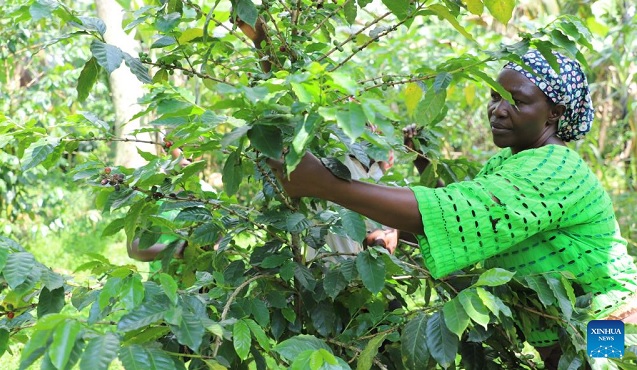
For women in agriculture, the EU Green Deal’s requirements exacerbate existing inequalities. Teopista Nakkungu of the Uganda Chapter of Women in Coffee, a global network of women that lobbies and advocates for the reduction of barriers that limit women’s meaningful participation in the coffee value chain explained: “Most women have limited access to land, finance, education, and information. High costs of certification, low digital skills, and limited access to extension services often leave women excluded from programmes in this male-dominated sector.”
Nakkungu emphasized that empowering women and youth is a strategic necessity: “We cannot meet EU traceability, carbon neutrality, and compliance requirements without unlocking the full potential of women and youth. Women spend 70% of their time participating in production. We need to build their capacities, promote innovation, and co-create solutions that address structural barriers.”
Through storytelling and branding, she added, women can capture value in coffee markets: “We are promoting women-produced coffees through story-based branding. The story is very clear—what she is doing, where, and how—and it creates value addition and market premiums.”
Lessons from Ghana’s cocoa traceability system
Yet, not all is bleak. Ghana’s Cocoa Traceability System demonstrates that compliance is possible with government support. Naidu highlighted Ghana’s model as a blueprint for Africa: “By pooling technology, finance, and infrastructure across government, private sector, and cooperatives, Ghana has shown that smallholders can be included in compliance systems.”
As a result, over 40,000 farms have been GPS-mapped, 20,000 farmers registered, with QR codes now tracking cocoa from farm to exporter. SMS-based reporting includes farmers with low literacy, dramatically reducing per-farmer compliance costs.
Historical EU-Africa context
Beyond regulations and costs, speakers repeatedly returned to history. Edward Mukiibi, the Team Leader at Slow Food-Uganda, framed the challenge in historical terms. “When we talk about EU-Africa trade, we are talking about 500 years of extractive history. Coffee, cocoa, sugarcane were commodified to feed Europe’s industrial revolution. These crops are high-value, but undervalued in Africa.”
“When we are producing coffee, we are producing a cash crop, a commodity to sell to the EU market… We get that little value. I don’t want to call raw coffee a low-value crop. It’s a high-value crop, but undervalued,” Mukiibi said.
“These crops are high-value crops, but they are undervalued. If we transform all that value here, they stop being low-value, raw materials. They become high-value, finished products. But to have that high-value finished product, we need to invest.”
Mukiibi urged African nations to invest in value addition: “If we want to produce chocolate, we need local processing technology. Simple roasting and grinding processes are affordable, but most equipment is expensive and imported. Unless we invest in local production capacity, we will remain suppliers of raw materials.”
He also highlighted trade negotiation strategies: “We need to negotiate access for finished products, not just raw commodities. EU investors should not displace local talent; Africans must retain control over value chains.”
Markets alone cannot deliver
The debate at Munyonyo repeatedly stressed the role of the state. Rangarirai Machemedze, SADC’s Tripartite Simplified Regime Coordinator, argued: “If compliance is now a market access instrument, the state must provide it as a public good. Markets alone won’t deliver structural transformation. Coordination, traceability, and compliance systems require state leadership.”
“If you look at the EU sustainability regulations, the EUDR that we’re talking about, the CBAM (Carbon Border Adjustment Mechanism), the CSDDD, as they are reshaping market access, our countries in the region must socialize compliant costs,” Machemedze said.
“And when we talk of socializing compliant costs, I am saying our investments should therefore look at building public traceability systems and shared registries to ensure that we re-price the risks, especially for the smallholder producers, which lowers unit-compliant costs and capture premium markets.”
“We will not be able to access these markets if our governments do not intervene. If the state does not intervene, we cannot leave this to the market. We cannot leave this to private actors. Compliance should be socialized. It should become a public good.”
“We have to go back to the role of the state. The state has a massive role to play in ensuring that no one is left behind,” he said. Machemedze recalled lessons from past development strategies: “We have seen that happening. Those who are in the norm of the history of development of this continent, you will understand that if you go back to the period of structural adjustment programmes, everything was left to the market.”
“There was this mantra that we need to roll back the frontiers of the state and roll forward the frontiers of the market. It did not work. Instead, what did we see? We saw de-agriculturalization. We saw de-industrialisation.” Machemedze said Africa cannot repeat that mistake.”
Experts raised concerns about fairness in EU regulations. Edgar Odari, the Executive Director of the Nairobi-based Eco News Africa, warned of inconsistencies in the EU Green Deal. “Sustainability measures have been weaponized. The EU may suspend directives for American companies while enforcing them on African exporters. Rules are being applied selectively,” he said.
He highlighted the need for vigilance: “African countries must engage actively in negotiations, bilateral and multilateral. We cannot rely solely on World Trade Organization (WTO) mechanisms; pro-lateral agreements are emerging that could further disadvantage African exporters if left unchecked.”
Regional coordination: EAC and beyond
Several speakers emphasized the importance of African unity in negotiations. Gideon Gatpan, the Chairperson of the East African Legislative Assembly (EALA) Committee on Agriculture, Natural Resources, and Tourism, noted: “Currently, East African countries often negotiate separately with the EU. Partner states sometimes go alone, weakening our collective bargaining power. We must negotiate with one voice—EAC, SADC, COMESA—to advance equitable trade.”
He highlighted practical challenges: “How much of our exports are deforestation-free or human-rights compliant? Almost none. Can Africa meet EU standards in time? If the EU has alternative markets, they may not accommodate us. Gatpan noted that Africa needs a paced, coordinated approach that includes technical support and phased compliance.”
Bohela Lunogelo (PhD), a Tanzanian agricultural economist also stressed the urgency of coordinated action. “We risk losing access to the EU unless we ensure that we are complying to the deforestation-free supply chain,” he said.
He called for a regional, multi-stakeholder approach. “We need policy harmonisation, investment in digital infrastructure, joint financing mechanisms, and strong advocacy.”
Policy and legal responses
The dialogue also tackled domestic policies. Gatpan and others stressed harmonizing land policies, protecting local seeds, and regulating hazardous chemicals. Francine Rutazana, the Chairperson of the EALA Committee on Communication, Trade, and Investment, emphasized infrastructural development and intra-Africa trade as foundations for negotiation: “We need to build strength within Africa before engaging internationally. One voice in trade negotiations is not a dream—it is achievable.”
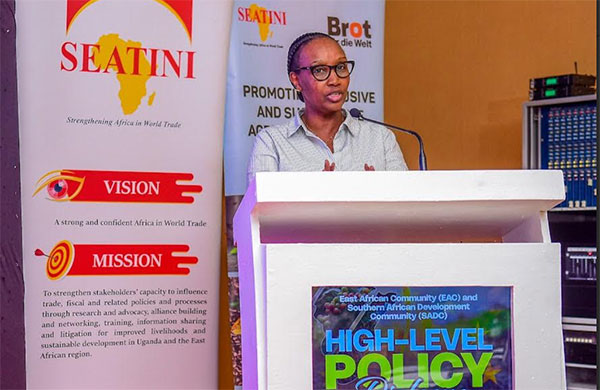
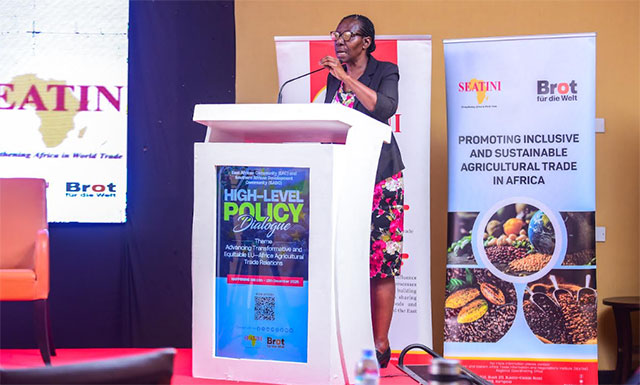
Jane Nalunga, the Executive Director of the Southern and Eastern Africa Trade Information and Negotiations Institute (SEATINI), the convener of the regional dialogue, framed the discussion around industrialization and trade justice. “Agricultural trade must drive productivity, industrialization, and job creation. The EU has historically benefited disproportionately. For trade to be transformative, Africa must move beyond commodity exports and capture value locally,” she said.
“Our economy is based on agriculture, but unless we link agriculture to industry, to trade, then we can’t evolve. That’s a fact which we need to agree and which we know. So, we need to ensure that we increase our production and productivity, we add value, we industrialise, we manufacture, and then we trade in value-added products,” she said on the opening of the two-day dialogue.
Financing, technology, and Public-Private Partnerships
Several experts proposed solutions to the EU Green Deal compliance burden. Dr. Lunogelo outlined a multi-pronged strategy: “Regional coordination, harmonized traceability systems, joint investment in digital infrastructure, capacity building, and public-private partnerships.
“We must pool resources to create regional sustainability funds to subsidize compliance costs. At present, European companies are already benefiting from green investments in Africa; our farmers should too,” he said.
Naidu added: “Compliance should not fall entirely on the farmer—it is a systemic issue. Public investment, collective infrastructure, and technical assistance are essential for inclusion.”
Negotiation, capacity, and inclusion
Experts urged a mix of negotiation, investment, and local empowerment. Mukiibi said: “Without technology, capacity, and coordinated policy, African farmers will remain at the mercy of EU regulations. We need equitable deadlines, support for smallholders, and a focus on finished products produced locally.”
Legislator Francine Rutazana framed the challenge as a call to action: “Africa has the resources, skills, and sovereignty to negotiate with the EU. But we must act together, with strategy, capacity, and determination. Our children’s future depends on it.” For now, as the clock ticks toward yet another revised deadline of the EUDR (30 December 2026) for implementation, the question is not whether Africa will comply, but how—and whether it can do so on its own terms.
The post Africa, EU Green Deal and plight of smallholder farmers appeared first on The Independent Uganda:.