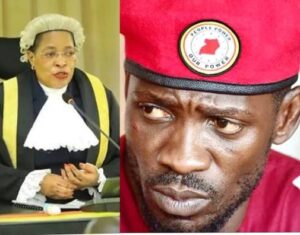
Do You Think You Can Manage Museveni Yet You Failed To Manage Me-Anita Among Tells Off Bobi Wine Ahead Of The 15th January General Elections
Uganda’s political scene has once again taken center stage, with Speaker Anita Among making bold statements against opposition leaders at a recent campaign rally in Nakawa. Among, a prominent figure in the National Resistance Movement (NRM), has challenged opposition politicians, questioning their ability to lead the country effectively. Her comments have sparked heated discussions across political circles.
During the rally, Among asked voters to stop investing their hopes and votes in opposition politicians who, according to her, will not deliver meaningful change. She emphasized that many opposition leaders often promise development but fail to understand the realities of governance.
Among particularly targeted Joel Ssenyonyi, the Nakawa Member of Parliament. She accused him of claiming to represent the marginalized while enjoying privileges comparable to high-ranking government officials, including the Deputy Speaker. Her words painted a picture of what she described as hypocrisy in opposition leadership.
The Speaker questioned why Ssenyonyi continues to portray himself as financially constrained when, in reality, he enjoys a lavish lifestyle supported by government allocations. She argued that his behavior demonstrates dishonesty and disrespect toward the very people he claims to serve.
Among went further to defend President Yoweri Museveni, describing him as a “good generous old man” whose policies and governance have supported not only leaders but also citizens indirectly. She suggested that opposition leaders are quick to criticize Museveni while benefiting from his leadership.
In her speech, Among also highlighted the importance of sophistication in leadership. She argued that leading Uganda requires experience, strategy, and the ability to manage a complex political and social environment, which she believes opposition leaders like Bobi Wine currently lack.
The Speaker did not hold back in criticizing Bobi Wine, dismissing him as a “joker” and questioning his readiness to govern a complicated nation like Uganda. Among stressed that Bobi Wine’s political party had been infiltrated and neutralized by her efforts, implying that he cannot stand up to the seasoned leadership of Museveni.
She reminded voters of the Bukedea incident, where she claimed to have successfully planted allies within the opposition party to secure the Bukedea Woman MP seat for her own candidate. Among used this example to demonstrate the opposition’s vulnerability and inability to protect its own leadership positions.

Among encouraged Nakawa residents to focus on practical daily activities, such as working and earning money, rather than investing time and energy in opposition leaders who, in her view, are more interested in political games than citizens’ welfare.
She portrayed the opposition as self-serving, suggesting that while they present themselves as champions of the poor, they are actually enriching themselves at the expense of ordinary citizens. Among’s speech framed NRM as the only party capable of delivering stability and development.
The Speaker urged voters to align with the “winning team” by supporting NRM candidates across the board. She predicted that continued support for opposition figures would keep voters in poverty while enriching the leaders themselves.
Among’s comments have sparked conversations about political loyalty, leadership experience, and the responsibilities of elected officials in Uganda. Her criticism of Ssenyonyi and Bobi Wine reflects a broader debate about who is best suited to govern the nation.
The Speaker’s emphasis on experience and strategic thinking in leadership resonates with many NRM supporters who argue that Uganda needs leaders with proven track records to manage its complex socio-political environment.
At the same time, her statements highlight a common criticism of opposition parties: internal divisions and susceptibility to manipulation. By pointing out the Bukedea incident, Among illustrated what she considers the opposition’s structural weaknesses.

Meanwhile, Uganda Communications Commission (UCC) has been active in ensuring that election-related communication and media reporting remain within legal boundaries. The agency has issued strict directives to broadcasters and social media administrators, warning against sharing unverified election results.
UCC Executive Director Hon. Nyombi Thembo emphasized that media houses and online group administrators must adhere to the law when reporting election outcomes. He clarified that anyone spreading fake or misleading information would face legal consequences, including fines or criminal charges.
The Commission stressed that only the Electoral Commission (EC) has the authority to officially announce election results. This ensures that information reaching the public is accurate, reducing confusion and potential unrest during elections.
WhatsApp group administrators and other social media managers are also not exempt from these rules. UCC warned that failing to moderate content or allowing false information to circulate can make them personally liable under Uganda’s Computer Misuse Act.
The combined messages from Speaker Among and UCC reflect Uganda’s tense pre-election atmosphere. On one hand, political leaders are rallying support and criticizing opponents, while on the other, regulatory authorities are safeguarding the integrity of election communication.
As Uganda approaches the next round of elections, these developments highlight the importance of responsible leadership, informed voting, and adherence to legal frameworks. Citizens are being urged to carefully evaluate both the promises and the credibility of political leaders before casting their votes.
The political landscape in Uganda remains highly competitive, with the ruling party asserting dominance while opposition figures continue to mobilize support. How voters respond to these messages will be crucial in shaping the nation’s future.